

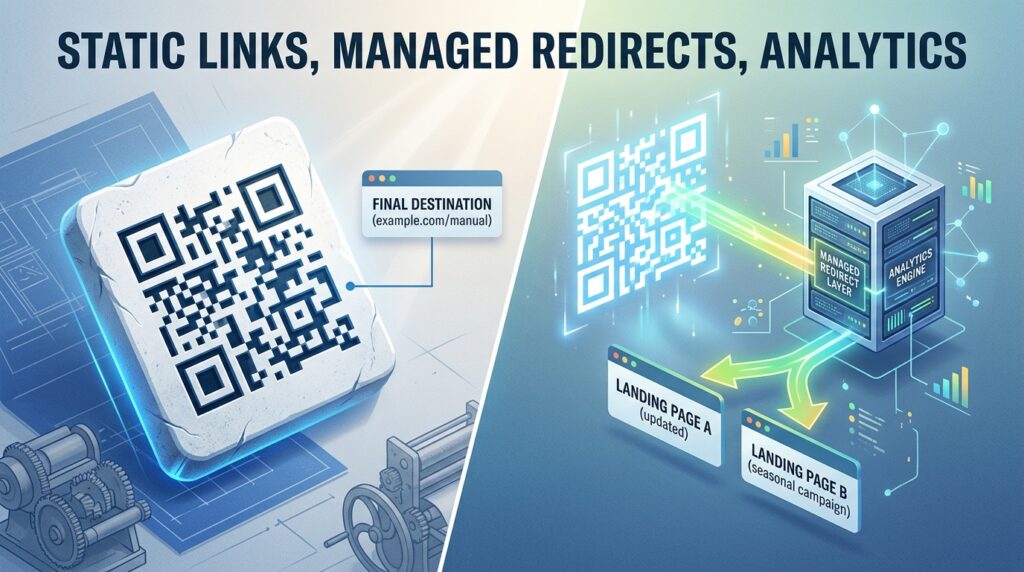
Static links, managed redirects, analytics, and the infrastructure that survives the print run
David Mariscal Fernández · Creator of ProQR
QR codes are often described as static or dynamic, as though the difference lives inside the black-and-white symbol. That is convenient language, but it can obscure the engineering decision that matters most after printing.
The printed pattern does not update remotely. What can change is the web infrastructure behind the URL encoded in it. Once that code appears on packaging, signage, menus, brochures, manuals, or product labels, a disposable digital link becomes a physical dependency. It may need to keep working long after the campaign, website structure, or software vendor that created it has changed.
The useful comparison is therefore not simply static versus dynamic QR codes. It is direct linking versus a managed redirect layer, and the operational trade-offs each architecture creates.
A static QR code is a direct pointer
In the simplest design, the QR code contains the final destination itself. A code might encode a URL such as https://example.com/manual. When a user scans it, the phone opens that address directly.
Printed QR -> Final destination
There are few moving parts. The organisation does not need a separate redirect service, a mapping database, or an account with a QR platform. If the destination remains available, the code can continue working indefinitely.
That simplicity is a real advantage, not a missing feature. For a permanent page on a domain the organisation controls, introducing another service can add failure modes without adding much value.
The limitation appears when the encoded URL can no longer be preserved. If a landing page is removed, a third-party service is replaced, or the wrong URL was printed, the physical code cannot be rewritten. The organisation must preserve compatibility at the old address or replace the printed material.
A managed redirect moves the changeable part to the server
What the market usually calls a dynamic QR code inserts an intermediate URL. The code might contain https://qr.example/abc123 rather than the final landing page. When the request reaches the redirect server, that identifier is mapped to a destination and the browser is sent there.
Printed QR -> Intermediate URL -> Redirect service -> Final destination
Changing the destination means updating the server-side mapping, not altering the printed symbol.
This distinction is not merely semantic. GS1 explains that redirection can keep a QR code static while allowing the linked information to change. In its technical guidance, GS1 also notes that the term “dynamic QR Code” can be confusing because everything physically printed on a product is static; the dynamic behavior is created by what happens after the scan.
That is a better mental model for evaluating QR infrastructure: the barcode is permanent, while the web routing behind it may or may not be editable.
The HTTP redirect itself is an engineering choice
A redirect is not a generic instruction with only one behaviour. The server normally answers with a 3xx HTTP status and a Location header, and the status code communicates whether the move should be treated as temporary or permanent.
For an intentionally editable QR destination, that choice should be deliberate. MDN distinguishes permanent redirects such as 301 and 308 from temporary redirects such as 302 and 307. A system whose destination is expected to change again should not casually communicate permanence to clients and crawlers. The correct status also depends on request semantics, although QR landing flows are normally simple GET requests.
This is a small implementation detail with a larger lesson: the quality of a managed QR system depends on ordinary web architecture, not on the QR image itself.
Printing turns URL mistakes into operational costs
A broken link on a website can often be fixed in minutes. A broken link on 20,000 printed inserts can become a logistics problem.
This is why reprint risk is more important than the QR code itself. The value of redirection grows with the cost and lifetime of the physical object carrying the code.
Consider packaging that will remain in distribution for eighteen months. During that period the product page may be redesigned, the support centre may move, regional destinations may change, or the company may replace a third-party platform. A direct QR is not necessarily doomed: if the company owns the encoded domain, it can often maintain the old URL and redirect it at the web-server level. But if that address cannot be preserved, the printed code becomes stranded.
A managed redirect provides a controlled point of indirection. The physical object keeps the same URL while the destination can evolve. In effect, some of the risk is transferred from the print layer to the software layer.
That transfer is valuable only when the new software dependency is managed well. A dynamic system does not remove risk; it changes its location.
Domain ownership can matter more than the QR platform
Two editable QR systems can look identical to the user and still create very different long-term risks.
In one design, the printed code points to a domain owned entirely by the QR provider. In another, it points to a subdomain controlled by the organisation, such as qr.company.com, with the redirect service operating behind it.
The second design can make migration easier. If the organisation retains control of the hostname, it may be able to move the redirect logic to another provider without changing the URL already printed in the physical world.
By contrast, a code printed with a provider-owned hostname can remain dependent on that provider for as long as the material is in circulation. Closure, account suspension, policy changes, pricing changes, or loss of access can all become physical-link problems.
For short-lived campaigns, that dependency may be acceptable. For a QR expected to remain on a product or document for years, the ownership of the encoded domain deserves the same attention as the dashboard features.
Scan analytics are useful, but they are easy to overinterpret
The redirect layer creates a natural measurement point. Before sending the browser to the final page, the server can record that its URL was requested and associate the request with a particular printed code or campaign.
Depending on the implementation and privacy choices, a system may record a timestamp, the QR identifier, broad location inferred from network information, or technical characteristics of the request. This can answer practical questions: Which placement generated more activity? When were codes used? Which campaign identifiers were requested most often?
But a redirect request is not the same thing as a unique person, and it is certainly not the same thing as a conversion. One person may make several requests. Network-derived location is approximate. A successful redirect does not reveal whether the user purchased, registered, or even stayed on the destination page.
The cleanest architecture separates scan measurement from downstream behaviour. The redirect service records that the physical entry point was used; the destination site measures what happened afterwards.
Campaign parameters can bridge those two layers. Google Analytics documents UTM parameters such as utm_source, utm_medium, and utm_campaign for identifying the campaigns that refer traffic. A QR redirect can preserve or append those parameters so the destination analytics system can attribute the resulting session to an offline campaign.
That produces a more defensible funnel: a scan or redirect event indicates use of the physical link, while destination analytics handles sessions and later conversions.
Privacy should be a design decision, not an analytics afterthought
Because a redirect server receives a web request before the destination loads, it also becomes part of the data-processing path. The fact that a signal can be collected does not mean it should be retained.
If the business question is simply whether one poster location generates more activity than another, aggregate campaign counts may be enough. Collecting additional identifiers or building individual profiles would create more privacy and security exposure without necessarily improving the decision.
For organisations subject to the GDPR, this principle aligns with European Commission guidance on data protection by design and by default, which emphasises building safeguards into processing from the start and, by default, processing only the personal data necessary for the intended purpose and keeping it no longer than necessary.
A useful implementation question is therefore not “What can we log?” but “What decision will this field help us make?” If there is no clear answer, the system may be better without it.
Editability also raises the security stakes
A redirect account may control destinations for hundreds or thousands of codes that are already printed and distributed. That makes account security part of the security of the physical material.
If an attacker gains the ability to edit destinations, the attacker does not need to replace a sticker, package, or sign. A server-side change can repoint every affected code remotely. Strong authentication, least-privilege access, logging, recovery procedures, and change controls therefore matter more as the number and lifetime of deployed codes increase.
Redirect endpoints themselves also need careful validation. OWASP documents open redirects as a security weakness that can be abused for phishing and as part of larger exploit chains. A QR platform should not accept arbitrary untrusted destinations through an exposed redirect parameter without appropriate validation and access controls.
The feature that makes a dynamic system useful – changing destinations centrally – is also the feature that increases the impact of compromised administrative access.
Reliability is part of the architecture
A direct QR pointing to a healthy URL has one obvious dependency: the destination must remain reachable. A managed redirect adds at least one more service, domain, DNS configuration, and database or routing layer to the request path.
That additional layer can fail. A redirect provider can have an outage. DNS can be misconfigured. A record can be deleted. An account can expire. A migration can break mappings.
The right conclusion is not that redirects are unreliable. Mature redirect infrastructure can be extremely robust. The point is that long-lived physical links deserve operational planning: backups of mappings, export capability, monitoring, a migration path, and clarity over who controls the domain.
The expected lifetime of the physical object should influence how much engineering discipline is justified. A QR on a two-day conference poster and a QR engraved on equipment should not be treated as the same reliability problem.
When direct linking is the stronger choice
A direct QR is often the better design when the destination is expected to remain stable, the organisation controls the domain, redirect-level analytics are unnecessary, and minimising dependencies is more important than remote editability.
A permanent documentation URL is a good example. If the organisation can guarantee that the URL will continue resolving even when the underlying site is rebuilt, an external QR management layer may solve no meaningful problem.
This is why treating dynamic QR codes as a universal upgrade is misleading. Additional infrastructure is valuable only when it addresses a real operational requirement.
When a managed redirect earns its complexity
A redirect becomes easier to justify when the final destination is likely to change, reprinting would be expensive or impossible, different physical placements need to be measured separately, or a controlled migration path is required.
The decision is less about features than about the relationship between two lifetimes: how long the physical code will exist, and how long you can confidently guarantee the destination behind it.
| Question | Direct URL in the QR | Managed redirect |
| Can the final destination change without reprinting? | Only if you can preserve or control the encoded URL | Yes, by updating the redirect mapping |
| Additional infrastructure dependency | Lower | Higher |
| Redirect-level scan measurement | Not inherent | Usually available |
| Long-term control | Strong when you own and preserve the encoded URL | Strongest when you also control the redirect domain |
| Migration complexity | Low | Depends heavily on domain ownership and exportability |
The QR code is the cheap part
Generating the symbol costs almost nothing. The expensive decision is choosing the infrastructure behind a link that may remain attached to a physical object for years.
For stable destinations on domains you control, direct linking can be the most durable and least complicated solution. For costly print runs, changeable destinations, or campaigns that need a controlled measurement layer, a managed redirect can protect against reprints and provide valuable flexibility.
That flexibility should be evaluated alongside domain ownership, provider dependence, privacy, security, migration, and uptime. The strongest architecture is not the one with the longest feature list. It is the one that is most likely to remain under your control for at least as long as the physical QR code remains in the world.
About Author
David Mariscal Fernández is the creator of ProQR, a web platform for creating and managing static and dynamic QR codes. The technical perspective in this article is informed in part by the product and infrastructure decisions encountered while building the platform.
Publish Your Article & Build Backlink Authority on Publcity
Looking to expand your digital reach, boost your search engine rankings, and secure high-authority backlinks? Publcity welcomes guest authors, brands, and SEO agencies to contribute premium articles. Get your content indexed, build domain authority, and tap into a global audience.
We accept original, do-follow contributions in Business, Marketing, Technology, Travel, and Culture.
Write for UsRead our Guest Posting Guidelines & Submit Your Draft Today!