

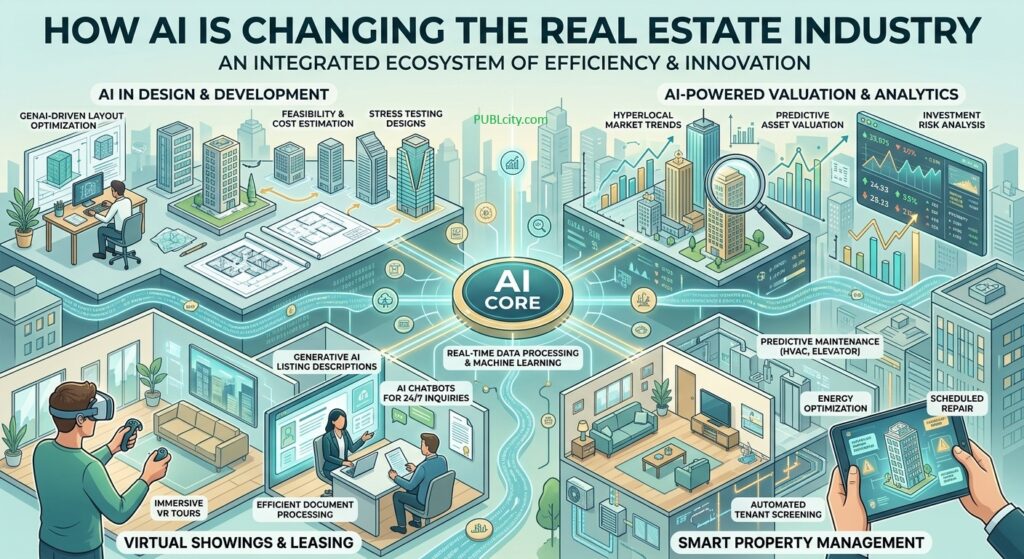
Artificial intelligence is changing how businesses work, and the real estate industry is increasingly becoming part of that transformation. From generating property descriptions to analyzing market data, responding to potential clients and improving administrative workflows, AI is giving real estate professionals new ways to handle tasks that once required significant amounts of time.
The technology is also changing the experience for buyers, sellers, investors and renters. Property searches can become more personalized, customer questions can receive faster responses, and large amounts of information can be processed more efficiently.
However, AI is not simply a new marketing tool for real estate. Its broader impact is being seen across property research, marketing, customer service, administration, investment analysis and property management.
For real estate professionals, the important question is no longer whether AI will become part of the industry. It is how these tools can be used responsibly while preserving the human expertise and relationships that remain central to real estate.
AI Is Making Real Estate Marketing Faster
Marketing has traditionally been one of the most time-consuming parts of selling and renting property.
A real estate professional may need to create listing descriptions, social media posts, email campaigns, newsletters, advertisements and website content for multiple properties.
AI can help speed up many of these tasks.
A professional can provide basic information about a property and use an AI writing tool to create an initial description. The same information can potentially be adapted into different formats for a website listing, social media post, email or advertisement.
This does not mean the AI-generated version should automatically be published.
Real estate professionals still need to review descriptions for accuracy. Property features, dimensions, locations, amenities, pricing and availability should be verified before publication.
Used properly, AI becomes a productivity tool rather than a replacement for professional judgment.
AI Can Improve Property Descriptions
Property listings compete for attention online. A buyer may scroll through dozens of listings before deciding which properties deserve closer attention.
AI can help agents organize information into clearer and more engaging descriptions.
For example, instead of manually rewriting the same property information for different platforms, an agent can use AI to create variations while maintaining the underlying facts.
AI can also help identify important information that should be highlighted in a listing.
A property located close to schools, transportation, shopping areas, restaurants or business districts may appeal to different audiences for different reasons. AI can help an agent structure the listing around these relevant characteristics.
The important distinction is between presentation and invention.
AI can improve how information is presented, but it should not be used to create property features that do not exist or make unsupported claims about a neighborhood or investment opportunity.
AI Is Changing How Buyers Search for Properties
Property searches have traditionally relied on filters such as location, price, number of bedrooms and property type.
AI could make these searches more conversational and personalized.
Instead of entering a series of filters, a prospective buyer might describe what they are looking for in ordinary language:
“I want a two-bedroom apartment close to public transportation, restaurants and a business district, with a moderate monthly budget.”
AI-powered systems can potentially interpret these preferences and help narrow the search.
This type of technology can make property discovery more accessible, particularly for people who are unfamiliar with a local market.
However, the quality of the recommendations depends heavily on the quality and accuracy of the underlying property data.
If information about prices, availability, locations or property characteristics is outdated, an AI system can still produce an answer that sounds convincing while being incorrect.
That makes data quality increasingly important in an AI-driven real estate environment.
AI Can Help Real Estate Professionals Respond to Leads
Speed matters when dealing with potential buyers, sellers and renters.
A person who submits an inquiry through a website may expect a response quickly. If an agent is unavailable, the potential client may move on to another listing or professional.
AI-powered chatbots and virtual assistants can provide basic responses outside normal working hours.
They can answer frequently asked questions, collect contact information, explain the next steps in a process and direct visitors toward relevant listings or resources.
For example, an AI assistant could help a website visitor understand what information is needed to arrange a property viewing.
The technology can handle repetitive questions while allowing the real estate professional to focus on conversations that require personal attention.
This is particularly useful for busy agents managing multiple listings and inquiries.
AI Is Helping Agents Analyze Market Information
Real estate professionals deal with large amounts of information.
Property prices, sales histories, rental rates, neighborhood characteristics, demographic information and economic indicators can all contribute to a decision.
AI can help process large datasets much faster than a person working manually.
For example, analytical systems can identify patterns in historical information and help professionals understand how prices or rents have changed over time.
This can support research and decision-making.
However, AI-generated analysis should not automatically be treated as a prediction of what will happen next.
Real estate markets are influenced by interest rates, employment, construction, government policy, infrastructure, local demand and many other factors.
An AI system can identify patterns in available data, but that does not guarantee that those patterns will continue.
Professional interpretation remains important.
AI Is Changing Property Investment Research
Property investors often need to compare multiple opportunities before making a decision.
AI can assist with organizing information about potential investments.
An investor might use AI to summarize publicly available market information, compare property characteristics, organize financial assumptions or identify questions that deserve further investigation.
AI can also help investors create different scenarios.
For example, an investor could examine how changes in rental income, operating expenses or vacancy assumptions would affect a property’s projected returns.
The value here is not that AI can tell an investor whether a property will make money.
Instead, it can help make the research process more organized and allow different assumptions to be examined more efficiently.
Investment decisions still require independent due diligence and, where appropriate, advice from qualified professionals.
AI Is Making Property Management More Efficient
The impact of AI extends beyond buying and selling.
Property management involves many repetitive tasks, including tenant communication, maintenance requests, scheduling and administrative work.
AI-powered systems can help organize incoming requests and direct them to the appropriate person or workflow.
For example, a tenant could submit a maintenance request through an online system. AI could categorize the request based on the information provided and help determine whether it should be handled by a plumber, electrician, maintenance worker or property manager.
AI can also help identify recurring maintenance issues by analyzing historical service requests.
Over time, this could help property managers recognize patterns and improve preventative maintenance.
The technology does not eliminate the need for property managers. Instead, it can reduce some of the administrative workload involved in managing properties.
AI Is Changing Real Estate Content Creation
Real estate companies are increasingly expected to maintain an online presence.
Websites, blogs, social media accounts, newsletters and video platforms all create opportunities to reach potential customers.
Creating enough content to maintain these channels can be difficult for smaller agencies and independent agents.
AI can help generate ideas, organize content calendars, draft articles and adapt existing material for different platforms.
An agent could turn a longer market article into a series of social media posts, a newsletter summary and a short video script.
This can make content marketing more manageable.
But there is a risk.
If real estate businesses simply publish large amounts of generic AI-generated content without adding local knowledge or professional experience, their websites may become less useful rather than more useful.
The strongest use of AI is often to assist the person who understands the market, not to replace that person’s knowledge.
AI Can Support Personalized Marketing
Real estate marketing is becoming increasingly data-driven.
Different buyers have different priorities. A first-time buyer may be interested in affordability and transportation. An investor may focus on rental demand and operating costs. A relocating professional may care about commute times, amenities and neighborhood characteristics.
AI can help organize customer information and create more personalized communication.
Instead of sending identical messages to every potential client, businesses can potentially use technology to tailor communications based on the person’s stated interests.
This can make marketing more relevant.
At the same time, real estate businesses need to be careful about how customer data is collected, stored and used. Privacy requirements and applicable laws should be considered before implementing AI systems that process personal information.
AI and Real Estate Photography
Visual presentation has always been important in property marketing, and AI is creating new possibilities in this area.
AI-powered image tools can help with tasks such as improving image quality, correcting lighting or creating certain types of visual marketing material.
However, property marketing requires particular care.
There is a meaningful difference between improving the presentation of an existing photograph and digitally changing the appearance of a property.
If an AI-generated image makes a room appear significantly larger, adds features that do not exist or otherwise gives a misleading impression, it can create problems for both the buyer and the real estate professional.
Transparency matters.
Technology should help potential buyers understand a property rather than create unrealistic expectations.
AI Will Not Replace the Human Side of Real Estate
One of the biggest misconceptions surrounding AI is that automation will eliminate the need for real estate professionals.
Real estate is not simply a database of properties.
Buying or selling a property can involve significant financial decisions, negotiations, uncertainty and personal circumstances.
Clients may need help understanding complicated information, negotiating terms, evaluating options and navigating a transaction.
These situations require communication and judgment.
A buyer may also have concerns that cannot be answered by a database. They may want to understand what living in a particular neighborhood feels like, how a property fits their lifestyle or which questions they should ask before making an offer.
Local knowledge and human relationships remain important.
AI can provide information and efficiency, but it does not automatically provide the trust that develops between a client and a knowledgeable professional.
The Importance of Accuracy and Human Oversight
As AI becomes more common in real estate, accuracy will become increasingly important.
AI systems can sometimes produce incorrect information, misunderstand questions or present assumptions as facts.
This creates particular risks in an industry where inaccurate information can have financial consequences.
Real estate professionals should therefore review AI-generated material before it is used with clients.
Property descriptions should be checked against actual property information. Market statistics should be verified against reliable sources. Financial calculations should be reviewed. Legal or regulatory information should not be accepted simply because an AI system provides a confident answer.
AI can accelerate work, but human oversight remains essential.
A Practical AI Adoption Roadmap for Real Estate Businesses
For a real estate business that has not used much AI yet, the biggest challenge can be knowing where to start.
The answer does not have to be complicated.
Rather than attempting to automate the entire business at once, companies can introduce AI gradually, measure the results and expand its use as employees become more comfortable with the technology.
Step 1: Identify Repetitive Tasks
Start by looking at the activities that consume time but do not necessarily require high-level professional judgment.
These might include:
- Drafting property descriptions
- Writing routine emails
- Creating social media captions
- Summarizing meeting notes
- Organizing research
- Generating content ideas
- Answering frequently asked questions
- Preparing internal documents
- Categorizing inquiries
- Creating marketing variations
Create a simple list of these tasks and estimate how much time employees currently spend on them.
The objective is to identify practical opportunities rather than adopt AI simply because it is fashionable.
Step 2: Choose One or Two Low-Risk Use Cases
Once repetitive tasks have been identified, select one or two areas for an initial experiment.
Content creation is often a relatively straightforward starting point.
For example, an agent could use AI to produce a first draft of a property description and then edit it personally before publishing.
Another business might use AI to turn an existing article into social media posts or a newsletter.
Starting small makes it easier to identify what works and what does not.
Step 3: Establish an AI Usage Policy
Before employees begin using AI extensively, businesses should establish basic guidelines.
The policy can address questions such as:
- What information can employees enter into AI tools?
- What customer information should never be entered?
- Which AI-generated materials require human review?
- Who is responsible for checking factual accuracy?
- Which tasks require approval from a manager?
- How should AI-generated images or content be disclosed when appropriate?
The exact requirements will vary by organization and jurisdiction, but having clear internal rules can reduce unnecessary risk.
Step 4: Train the Team
AI tools are only as useful as the people using them.
Employees should learn how to provide clear instructions, check outputs, identify inaccurate information and refine AI-generated material.
Training should also emphasize that AI output is a starting point rather than an unquestionable answer.
A real estate professional who understands the local market can often improve an AI-generated draft substantially by adding relevant experience and context.
Step 5: Measure the Results
After introducing an AI workflow, measure whether it actually improves the business.
Useful measures could include:
- Time saved per task
- Number of leads handled
- Response time
- Content production
- Administrative workload
- Employee productivity
- Customer satisfaction
- Conversion rates
For example, if creating a property listing previously required 30 minutes and an AI-assisted workflow reduces the drafting process to 10 minutes while maintaining quality, the business has a measurable productivity gain.
Step 6: Expand Carefully
Once an AI workflow has demonstrated value, the business can consider additional applications.
A company might move from AI-assisted content creation to customer-service automation, data analysis, lead qualification or property-management workflows.
The key is to expand based on evidence rather than trying to automate everything at once.
Step 7: Keep Humans in the Loop
Even as AI adoption increases, businesses should identify decisions that require human involvement.
Client advice, negotiations, sensitive communications, financial decisions, property representations and other high-impact activities may require professional review.
AI should support these processes rather than automatically make decisions on behalf of the business or its clients.
What Real Estate Professionals Should Do Now
Real estate professionals do not necessarily need to adopt every new AI tool.
A better approach is to identify repetitive tasks where technology can provide genuine value.
For example, an agent could begin by using AI to:
- Generate first drafts of property descriptions
- Brainstorm content ideas
- Summarize research
- Organize notes
- Draft email responses
- Create social media variations
- Develop marketing calendars
- Analyze structured datasets
- Answer routine website questions
- Create internal administrative workflows
The goal should be to save time without sacrificing accuracy or the personal service clients expect.
Professionals should also establish clear rules for how AI is used within their business. Sensitive customer information should not be entered into tools without understanding how that information is handled, and AI-generated information should be reviewed before being shared publicly.
The Future of AI in Real Estate
The use of artificial intelligence in real estate is likely to continue expanding as technology becomes more accessible and businesses become more comfortable incorporating it into everyday workflows.
Future systems may make property searches more conversational, automate more administrative tasks, provide more sophisticated market analysis and create increasingly personalized customer experiences.
But the technology will not remove the fundamental need for reliable property information, local knowledge, professional judgment and human relationships.
The real opportunity for real estate professionals is to use AI to reduce repetitive work and create more time for the activities where human expertise matters most.
An agent who spends less time writing routine emails, organizing information and completing repetitive administrative tasks may have more time to communicate with clients, build relationships, understand local markets and negotiate transactions.
That is where AI’s role in real estate may become most significant.
Rather than viewing artificial intelligence simply as a replacement for traditional real estate work, it can be understood as another tool in the professional’s toolkit.
The businesses that use it effectively will not necessarily be the ones using the most AI. They may be the ones that understand where automation adds value, where human judgment is essential and how the two can work together.
The Fundamental
AI is changing the real estate industry across marketing, property searches, customer service, investment research, property management and content creation.
For professionals, the technology offers an opportunity to work more efficiently and handle information at a greater scale. For buyers, sellers, renters and investors, it can make parts of the property search and research process faster and more personalized.
But AI also introduces new responsibilities.
Accuracy, transparency, privacy and human oversight remain important, particularly when technology is being used in decisions involving significant financial commitments.
The future of real estate is unlikely to be entirely human or entirely automated. Instead, it will increasingly involve professionals using AI to handle certain tasks while relying on experience, relationships and judgment for the decisions that require a human perspective.
For real estate businesses willing to experiment carefully and use the technology responsibly, AI can become less about replacing people and more about helping them work better.
Publish Your Article & Build Backlink Authority on Publcity
Looking to expand your digital reach, boost your search engine rankings, and secure high-authority backlinks? Publcity welcomes guest authors, brands, and SEO agencies to contribute premium articles. Get your content indexed, build domain authority, and tap into a global audience.
We accept original, do-follow contributions in Business, Marketing, Technology, Travel, and Culture.
Write for UsRead our Guest Posting Guidelines & Submit Your Draft Today!