

By Jeffrey Wilson / DJ 750
Independent artists have more ways to reach listeners than at any previous point in the music business. A record can move from a home studio to worldwide distribution within days. A performance clip can introduce an unknown act to thousands of people overnight. Streaming platforms, independent radio, podcasts, DJs, blogs and social media can all create discovery without waiting for a traditional gatekeeper.
That access represents real progress. It has also created a dangerous misunderstanding: reach is not the same thing as ownership, and attention is not the same thing as an audience.
Artists can accumulate streams, views and followers while remaining unable to reliably reach those same people when the next song, show or product arrives. The numbers are genuine, but the connection is often controlled by somebody else’s platform, recommendation system or business priorities.
This does not mean artists should abandon streaming or social media. Those platforms remain powerful discovery engines. The strategic mistake is expecting discovery platforms to perform every job an artist’s business requires.
Discovery creates the introduction. Direct-to-fan infrastructure gives that introduction somewhere to go.
THE DIFFERENCE BETWEEN ACCESS AND DEPENDENCE
A follower is valuable, but an artist does not control whether every follower sees every post. A stream is valuable, but a listener can enjoy a playlist placement and move on without remembering the artist’s name. A viral clip can be valuable, but the audience may disappear as quickly as it arrived.
Each platform offers access to attention. Dependence begins when an artist has no reliable way to reconnect with the people reached there.
The practical solution is not withdrawal. It is diversification.
Streaming can make the music accessible. Social platforms can create conversation and discovery. Radio and DJs can provide repetition. Interviews and editorial coverage can build context, credibility and searchable history. Live events can turn recognition into community. Websites, email lists, text communities, ticketing systems and direct commerce can preserve the relationship.
The strongest independent strategy connects these functions instead of asking one platform to do everything.
ASK A BETTER QUESTION AFTER EVERY CAMPAIGN
Music marketing usually begins with acquisition metrics:
- How many streams?
- How many views?
- How many impressions?
- How many followers?
Those measurements matter, but they do not show what remains after the campaign ends.
A more useful question is: How many of the people reached this month can the artist reach again next month?
That question changes the definition of success.
If a campaign produces 100,000 video views, did searches for the artist increase? Did listeners save the record, explore the catalog or follow the artist on a second channel? Did anyone join an email list, buy a ticket, purchase merchandise or visit the artist’s website? Did the audience begin recognizing the artist’s name?
These outcomes reveal whether temporary attention is becoming a durable audience.
Virality and audience development are different jobs. Virality accelerates exposure. Audience development retains a portion of that exposure. Without retention infrastructure, artists can become trapped in an expensive cycle: release, promote, generate numbers, lose contact and start over.
A healthy campaign leaves something behind.
BUILD THE DESTINATION BEFORE THE TRAFFIC ARRIVES
One of the most common mistakes in independent promotion is waiting for success before creating the systems needed to capture it.
The better approach is to prepare the destination first.
An artist does not need a complicated technology stack. The artist needs a clear next step for an interested listener. That step might be an official website, an email or text list, a ticket page, a membership community, a merchandise store or another channel that supports an ongoing relationship.
The route will differ by artist, but the principle is consistent: every meaningful exposure should lead somewhere.
This idea is already visible in the tools major platforms provide. Spotify encourages artists to build followers so new releases can reach listeners through Release Radar and the What’s New feed. Bandcamp allows fans who purchase or follow an artist to opt into the artist’s mailing list, and it gives artists the ability to export collected addresses. Patreon provides creators with relationship-management tools for communicating with members and delivering benefits.
These tools work differently, but they reflect the same business reality: discovery becomes more valuable when it produces continuity.
SMALL, REACHABLE AUDIENCES CAN OUTPERFORM LARGE, PASSIVE ONES
Public follower counts are easy to treat as a scoreboard. They are visible, comparable and emotionally rewarding. Yet audience quality can matter more than audience size.
A smaller group of listeners who open messages, save releases, attend shows, buy merchandise and recommend the music may provide a stronger foundation than a much larger audience that rarely responds.
That does not make scale unimportant. It changes the order of operations.
First, build a relationship strong enough to produce repeat action. Then scale the system that supports it.
For an independent artist, geographic concentration can also matter. Five hundred active supporters in one city may create more immediate opportunity than thousands of passive listeners scattered across the world. Concentrated support can influence ticket sales, local radio interest, promoter confidence, media coverage and word-of-mouth momentum.
Reach creates possibility. Density and repeat behavior create leverage.
DIRECT-TO-FAN IS AN OPERATING SYSTEM
Direct-to-fan should not be reduced to collecting email addresses or selling merchandise. It is an operating philosophy built around continuity.
It asks artists to consider what happens after discovery, how listeners move between platforms, what information the artist can ethically retain with permission, and how each campaign contributes to the next one.
A direct-to-fan system may include several layers:
- A discovery layer built through social media, streaming, radio, DJs and editorial coverage.
- A destination layer built around an official website or organized landing page.
- A relationship layer built through permission-based email, text, membership or community.
- A commerce layer that supports tickets, music, merchandise, services or experiences.
- A measurement layer that tracks saves, searches, return visits, sign-ups, purchases and repeat participation, not impressions alone.
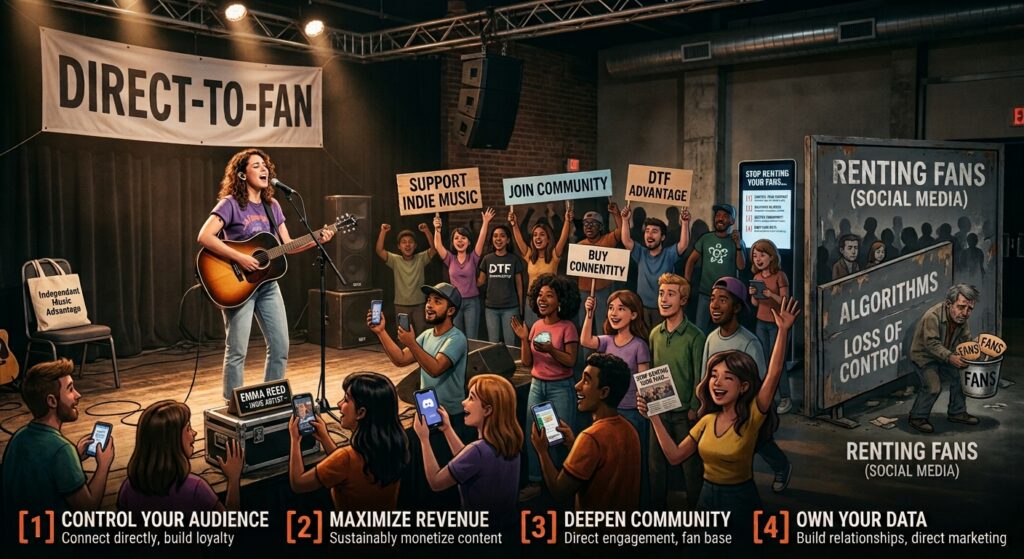
The objective is not to “own” people. Fans always control their attention and their information. The objective is to reduce the artist’s total dependence on rented access.
THE NEXT PHASE OF INDEPENDENCE
For years, music independence was discussed primarily in terms of production, ownership and distribution. Could artists record professionally without a major studio? Could they keep their masters? Could they distribute worldwide without a traditional label?
Technology has made the answer increasingly clear: yes.
The next phase concerns the audience.
Can an artist build a sustainable career without depending entirely on one company, algorithm or discovery channel to reconnect with listeners?
The answer can also be yes, but only when attention is treated as the beginning of a relationship instead of the final result.
Independent artists should continue using every platform that helps them reach people. They should pursue playlists, radio rotation, social discovery, press coverage, live opportunities and algorithmic recommendations. But every campaign should also create a clear path toward deeper connection.
Because the most valuable result of a successful campaign is not simply how many people encountered the artist.
It is how many have a reason and a reliable way to come back.
About Author
Jeffrey Wilson, professionally known as DJ 750, is the founder of My750 Music Network, an independent music and media network spanning internet radio, editorial media, podcasts, DJ programming, artist promotion and music discovery. His work focuses on independent-artist development, audience-building strategy and the evolving infrastructure connecting artists, media and listeners.
SOURCE NOTES
Spotify for Artists, “New Releases”:
https://artists.spotify.com/new-releases
Bandcamp Help Center, “How do I collect emails?”:
https://get.bandcamp.help/en/articles/15263065-how-do-i-collect-emails
Bandcamp Help Center, “How do I export the emails I’ve collected?”:
https://get.bandcamp.help/en/articles/15263126-how-do-i-export-the-emails-i-ve-collected
Patreon Help Center, “How to use your Relationship Manager”:
https://support.patreon.com/hc/en-us/articles/360045516212-How-to-use-your-Relationship-manager
Publish Your Article & Build Backlink Authority on Publcity
Looking to expand your digital reach, boost your search engine rankings, and secure high-authority backlinks? Publcity welcomes guest authors, brands, and SEO agencies to contribute premium articles. Get your content indexed, build domain authority, and tap into a global audience.
We accept original, do-follow contributions in Business, Marketing, Technology, Travel, and Culture.
Write for UsRead our Guest Posting Guidelines & Submit Your Draft Today!