
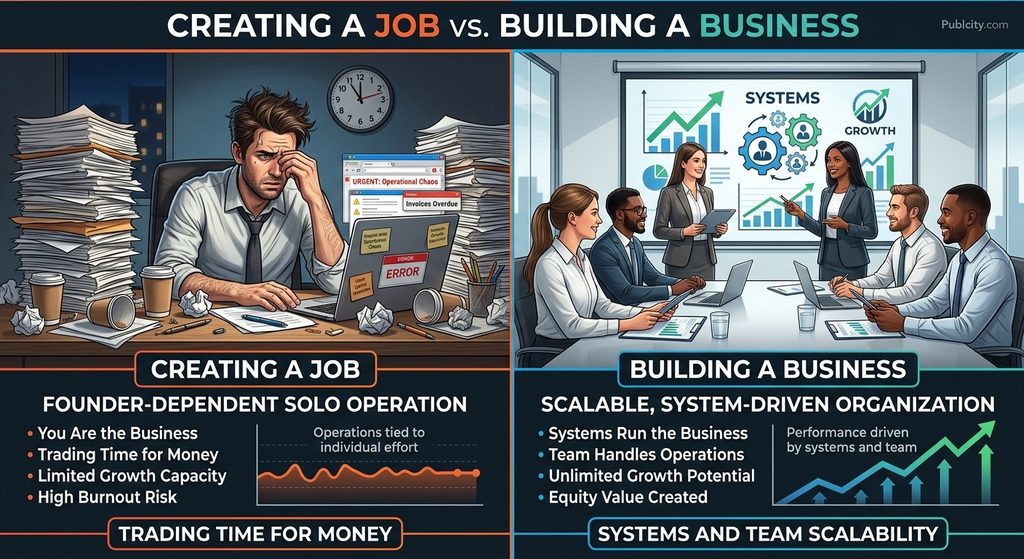
Entrepreneurship is often associated with freedom, financial independence and the opportunity to build something meaningful. For many people, starting a business represents an escape from traditional employment, a chance to pursue an idea, or an opportunity to turn a personal skill into a source of income.
Yet there is an important distinction that many aspiring entrepreneurs overlook: starting a business does not necessarily mean building a business.
Thousands of entrepreneurs establish businesses every year, but many end up creating something that looks remarkably similar to the jobs they originally wanted to leave behind. They work longer hours, carry greater responsibilities, make every important decision and become increasingly dependent on their own ability to keep the operation running.
They may own the company, control its direction and determine how much they earn, but the business cannot function without them.
This is the difference between creating a job for yourself and building a business.
Both approaches can be valuable. Self-employment provides independence, flexibility and an opportunity to earn directly from one’s skills. However, building a sustainable business requires something more: systems, structure, people, financial discipline and the ability to create value beyond the founder’s personal involvement.
Understanding this distinction is one of the most important steps an entrepreneur can take when deciding what they actually want to build.
The Self-Employment Trap
One of the most common misconceptions about entrepreneurship is that being your own boss automatically creates freedom.
In reality, many business owners discover that they have exchanged one demanding employer for dozens of demanding customers.
Consider a freelance graphic designer who decides to establish a design business. Initially, the arrangement seems straightforward. Clients request designs, the designer completes the work, invoices are issued and income is generated.
As demand increases, the designer takes on more clients, works additional hours and begins earning more money.
Eventually, however, a problem emerges.
There are only so many hours in a day. Every new project requires the founder’s time, every client expects their attention, and every deadline depends on their ability to deliver.
The business has reached a point where growth is limited by the founder’s personal capacity.
The same situation occurs across many industries.
A restaurant owner who must personally supervise every shift, a marketing consultant who handles every client account, a contractor who manages every project and a retailer who is responsible for every operational decision may all be running profitable businesses. However, their operations remain heavily dependent on their individual involvement.
The problem is not that these entrepreneurs are unsuccessful. The problem is that their business models may have been designed around their labour rather than around a scalable operation.
In effect, they have created employment for themselves.
What Does It Actually Mean to Build a Business?
Building a business means creating an organisation capable of consistently delivering value through a combination of people, processes, resources, technology and intellectual assets.
The founder remains important, particularly during the early stages, but the company is not entirely dependent on the founder performing every task.
A properly structured business has identifiable operating procedures, defined responsibilities, reliable revenue-generating activities and systems that allow work to continue even when the owner is not directly involved.
Consider the difference between a consultant who personally delivers every service and a consulting firm that has developed a repeatable methodology, employs qualified professionals, manages client relationships through structured processes and has the capacity to serve multiple clients simultaneously.
Both businesses may provide similar services. However, their operating models are fundamentally different.
The first sells primarily the founder’s time and expertise. The second has developed an organisation that can deliver expertise through a broader operating structure.
This is what makes a business more than an extension of its owner’s working hours.
A business should ideally be capable of creating value independently of the founder’s daily labour. That does not mean the owner becomes unnecessary. It means the owner’s role evolves from being the person responsible for completing everything to the person responsible for building, directing and improving the organisation.
Five Important Differences Between the Two Approaches
1. Selling Your Time Versus Building Systems
One of the clearest differences between self-employment and business ownership is how revenue is generated.
When someone creates a job for themselves, income is often directly connected to the number of hours they work or the number of tasks they personally complete.
A photographer, for example, may earn money from every assignment. If they complete five projects in a month, they receive payment for five projects. If they become unavailable, their ability to generate revenue may decline significantly.
A business built around systems approaches the opportunity differently.
The photographer could develop a studio with additional photographers, editors, administrative support and standardised customer processes. The company could handle more assignments without requiring the founder to personally complete every photograph or edit every image.
The founder’s expertise still contributes to the quality of the service, but the business has developed a mechanism for delivering that service beyond one person’s capacity.
Systems are not limited to large corporations. Even small businesses can introduce standard procedures for customer onboarding, invoicing, scheduling, sales, inventory management and service delivery.
The objective is to make important activities repeatable rather than dependent on memory, improvisation or constant supervision.
2. Being Indispensable Versus Building a Capable Team
Many entrepreneurs take pride in being the person who knows everything about their business.
They know every customer, understand every process, handle every supplier relationship and resolve every operational problem.
Initially, this level of involvement may be necessary. In the early stages, founders frequently operate with limited resources and must perform several responsibilities themselves.
However, remaining indispensable can eventually become a serious business limitation.
When every decision requires the owner’s approval, employees become dependent rather than empowered. Projects slow down, customers experience delays and the founder becomes overwhelmed by routine responsibilities.
Building a business requires a different mindset.
Instead of asking how to personally complete every task, entrepreneurs must begin asking who can take responsibility for it, what training is required and what systems would allow the task to be completed consistently.
Delegation is not simply assigning work to another person. It involves establishing expectations, providing the necessary resources and creating accountability.
A capable team gives the business greater operational capacity while allowing the founder to concentrate on strategy, relationships, innovation and growth.
The goal should not be to build an organisation in which the owner does everything exceptionally well. It should be to build one in which the right people can perform their responsibilities effectively.
3. Generating Income Versus Building Long-Term Business Value
A business can generate substantial income without necessarily developing significant long-term value.
For example, an independent professional may earn an excellent income from a loyal customer base. However, if those customers only maintain relationships with that individual, the business may have limited value beyond the owner’s ability to continue providing the service.
A company with documented processes, transferable customer relationships, a recognised brand, trained employees, reliable financial records and predictable revenue may be more valuable because its operations are not entirely dependent on one individual.
This distinction matters when considering the future of a business.
An entrepreneur may eventually want to sell the company, bring in investors, appoint a managing director, pass the business to family members or simply reduce their involvement.
These possibilities become difficult when the entire operation revolves around the founder.
Long-term business value is developed through assets and capabilities that remain useful even when ownership or management changes.
These may include:
- A recognised and trusted brand.
- A loyal customer base.
- Intellectual property and proprietary processes.
- Technology and operational infrastructure.
- Documented systems and procedures.
- A capable management team.
- Consistent revenue and sound financial records.
- Established supplier and distribution relationships.
Not every business needs to become a large corporation or be prepared for acquisition. Nevertheless, building transferable value creates more options for the owner.
4. Reacting to Daily Problems Versus Managing Strategic Growth
Entrepreneurs who create jobs for themselves often spend most of their time responding to immediate operational demands.
A customer has a problem. A supplier is late. An employee needs assistance. An invoice has not been paid. A deadline is approaching.
The founder becomes the central problem-solving mechanism.
Although operational involvement is necessary, a business owner who spends every day dealing with immediate issues may struggle to focus on the decisions that determine the company’s future.
Building a business requires making time for strategic management.
This includes examining financial performance, identifying new markets, improving products and services, strengthening customer relationships, evaluating competitors and developing new sources of revenue.
The distinction is important because operational activity and strategic progress are not the same thing.
Being busy does not necessarily mean a business is growing.
A founder can spend twelve hours a day working inside the business while making very little progress towards making it more sustainable.
The challenge is to gradually create enough operational structure to spend more time working on the business rather than constantly working within it.
5. Dependence on Personal Effort Versus Repeatable Revenue
A self-employed professional may have to find new clients, complete the work and collect payment repeatedly.
When the work stops, income may also stop.
A business with a stronger recurring revenue model can develop greater predictability.
Examples include:
- Monthly service contracts.
- Subscription-based products.
- Membership programmes.
- Software subscriptions.
- Maintenance agreements.
- Retainer arrangements.
- Recurring supply contracts.
Recurring revenue does not automatically make a business successful. Customer retention, delivery costs, profitability and service quality still matter.
However, predictable revenue can make financial planning easier and reduce the pressure to constantly generate new sales.
The broader lesson is that entrepreneurs should consider how their business can create lasting customer relationships rather than relying exclusively on individual transactions.
Why So Many Entrepreneurs Get Stuck
If building a business is so important, why do so many entrepreneurs remain trapped in self-employment?
There are several reasons.
They confuse revenue growth with business growth.
When sales increase, entrepreneurs naturally assume the business is becoming stronger. However, increasing revenue can also increase workload, operating costs and complexity.
If every additional dollar earned requires a proportional increase in the founder’s personal effort, the business may be growing financially without becoming more sustainable.
They struggle to delegate.
Some founders believe nobody can perform tasks as well as they can. Others worry about losing control or making mistakes costly to the business.
Although these concerns can be legitimate, refusing to delegate prevents employees from developing and restricts the organisation’s capacity.
They underinvest in infrastructure.
Small businesses frequently prioritise immediate expenses while postponing investments in accounting systems, customer management tools, employee training, automation and documented processes.
These investments may not produce immediate revenue, but they can create the foundation for future growth.
They have not defined what success means.
Some entrepreneurs want financial independence and flexibility. Others want to build a large organisation, employ hundreds of people or establish a company that can eventually operate without them.
There is nothing inherently wrong with either ambition.
The problem arises when entrepreneurs pursue one objective while measuring success according to another.
Someone who wants a flexible lifestyle business may not need a large workforce or complex organisational structure. Someone who wants to build a company capable of entering multiple markets will need a very different strategy.
Clarity about the desired outcome should influence how the business is designed.
How to Move From Self-Employment to Building a Real Business
The transition does not happen overnight. It requires deliberate decisions and a willingness to change how the business operates.
Start by identifying everything that depends on you
Entrepreneurs should examine their daily responsibilities and identify which activities require their direct involvement.
These may include sales, customer service, administration, production, purchasing, marketing, bookkeeping and project management.
The purpose is to understand where the founder has become an operational bottleneck.
Some responsibilities may genuinely require the owner’s expertise. Others may be delegated, automated or eliminated.
Document important business processes
If an employee cannot understand how a task should be completed without constantly asking the owner, the process probably needs better documentation.
Create straightforward procedures for recurring activities.
For example, document how new customers are onboarded, how orders are processed, how complaints are handled and how invoices are issued.
These procedures help establish consistency, simplify training and reduce dependence on individual employees.
Build a business model that supports growth
Entrepreneurs should regularly examine whether their current revenue model can support expansion.
Can the service be delivered to more customers without requiring the founder to personally perform every task? Can products be sold through additional channels? Can customers purchase recurring services? Can technology reduce repetitive work?
The answers will depend on the industry, available resources and customer expectations.
Growth does not always require hiring more employees. Sometimes it requires redesigning the product, improving distribution or automating a process.
Invest in people before the workload becomes unmanageable
Hiring should be connected to a clear business need.
The objective is not simply to employ people because the business appears successful. It is to bring in capabilities that improve delivery, create operational capacity or support strategic growth.
Entrepreneurs should identify the responsibilities that consume the most time and determine whether another person could manage them effectively.
Develop financial discipline
A business should maintain accurate financial records, understand its operating costs and distinguish between business revenue and personal income.
Founders should establish appropriate compensation for themselves, maintain cash reserves where possible and understand the financial implications of hiring, expansion and investment.
A company that generates impressive sales but cannot consistently manage its cash flow is not necessarily a healthy business.
Financial discipline becomes increasingly important as the organisation grows.
Measure progress beyond revenue
Revenue is important, but it is not the only indicator of business health.
Entrepreneurs should also monitor customer retention, profitability, operating costs, employee productivity, recurring revenue and the degree to which operations depend on the founder.
An especially useful question is:
If you were unavailable for 30 days, could your business continue operating effectively?
The answer can reveal more about the strength of the organisation than its monthly sales figures.
Does Every Entrepreneur Need to Build a Scalable Company?
It is important to recognise that not every entrepreneur needs to build a large organisation.
There is nothing wrong with operating as an independent consultant, freelancer, creative professional or small business owner.
For some people, self-employment provides precisely what they want: control over their schedule, direct relationships with customers, professional independence and a manageable operation.
A well-designed lifestyle business can be profitable, rewarding and sustainable.
The distinction is not about suggesting that one approach is superior to the other. It is about understanding the differences and making intentional decisions.
A self-employed person may prioritise personal income and flexibility. A founder building a scalable business may prioritise organisational capacity, market share, transferable assets and long-term enterprise value.
Both can be legitimate forms of entrepreneurship.
However, the entrepreneur who wants to create something that can grow beyond their individual contribution must eventually move away from a model that depends entirely on personal effort.
The Real Measure of Entrepreneurial Success
There is a tendency to measure entrepreneurship through visible indicators: revenue, office space, employee numbers, social media attention and public recognition.
These measures can be useful, but they do not always reveal whether a business is fundamentally sustainable.
A more meaningful assessment considers the strength of the organisation behind the numbers.
Can the business consistently deliver value? Does it have reliable systems? Can employees make decisions within clearly defined responsibilities? Does it maintain healthy financial practices? Can it retain customers? Is it capable of adapting to changing market conditions?
Most importantly, can it continue creating value without requiring the founder to personally manage every detail?
Building a business is ultimately an exercise in creating something that can function, develop and endure beyond the individual who started it.
That requires entrepreneurs to change how they think about their role.
In the beginning, founders often have to do everything. As the organisation develops, however, their greatest contribution should increasingly come from building the conditions that allow other people, processes and resources to produce results.
The transition from operator to business builder is not always easy. It requires patience, investment, discipline and the willingness to relinquish some control.
But it is an important transition for anyone who wants to create a company with lasting potential.
Building a Business vs Creating a Job
Creating a job for yourself can be a valuable first step towards independence. It allows individuals to turn skills, knowledge and ideas into income while gaining experience in managing customers, finances and operations.
However, building a business requires a broader vision.
It means moving beyond the idea that the founder must personally deliver every product or service and instead developing an organisation capable of creating value consistently.
The difference is not simply how much money a business earns or how many employees it has. It is the extent to which the company has developed the systems, people, assets and operating structure necessary to function and grow beyond its founder’s daily involvement.
Entrepreneurs should therefore ask themselves an important question: Are they building an organisation that can grow, or are they simply creating a more demanding job for themselves?
The answer may determine not only how successful the business becomes, but also what kind of future its founder will ultimately have.
Because the real achievement of entrepreneurship is not just creating a business that pays you. It is creating a business that can continue creating value without depending entirely on you.
Lets highlight your brand?
Promote your article on Publcity to showcase your business, expertise, services or ideas.
Explore Sponsored Publishing Options → Promote your existing article choose our Write-for-you option.Submit Free Guest Posts
Have an original story, useful insight or professional perspective to share? Publcity welcomes contributions across Business, Marketing, Technology, Travel and Culture.
Review the submission guidelines before sending your article.