

How Automotive IoT Is Turning Vehicles Into Connected Digital Platforms
From Hardware Product to Software Platform
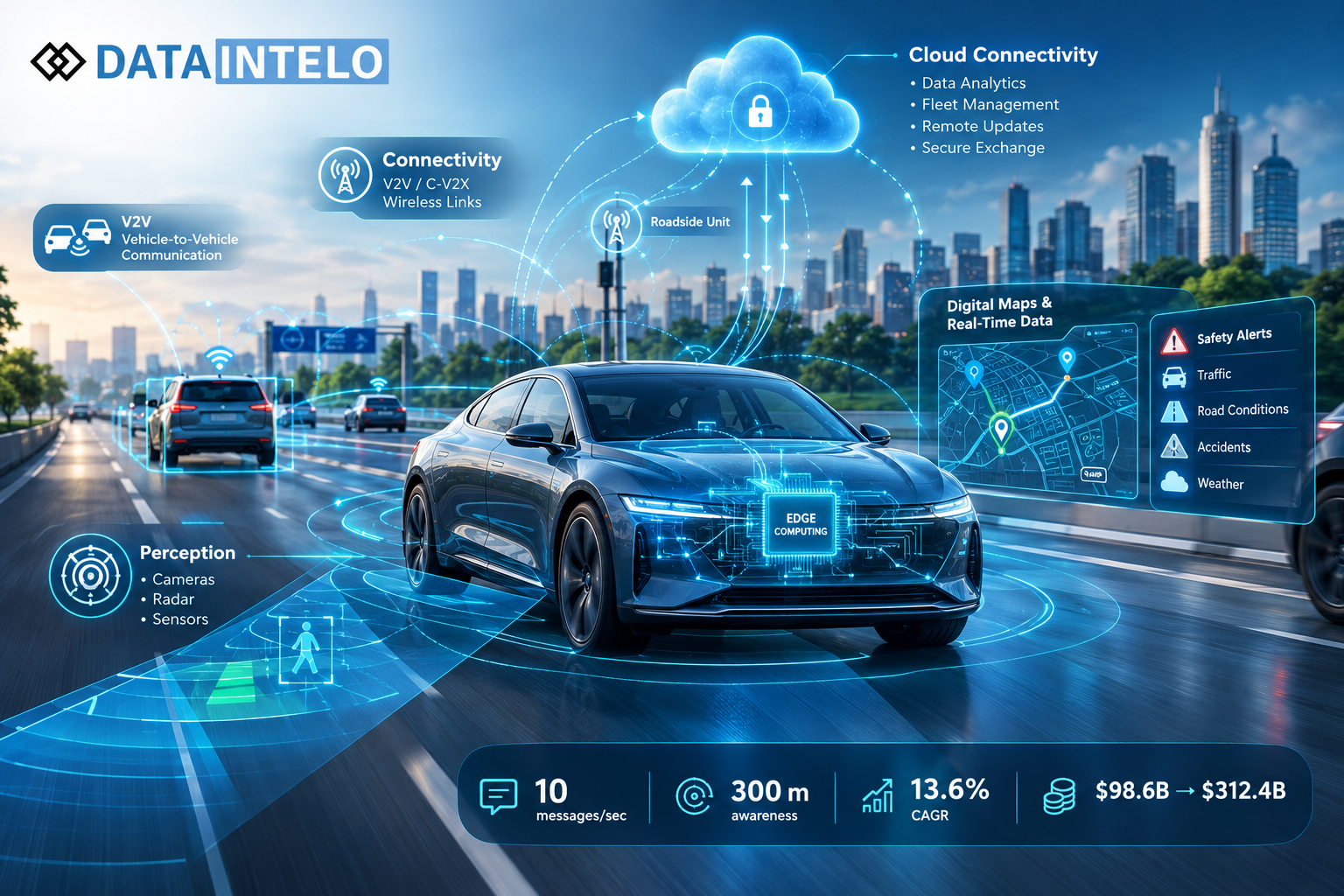
A contemporary automobile is no longer just considered as an engine, a chassis and four wheels. Instead, it has become a moving node of a network that is capable of sensing the surrounding environment, exchanging information with other road users, and improving through software. This is proved by federal research stating how much this field progressed over time. For example, the NHTSA stated that automobiles can send up to ten safety messages to nearby vehicles each second within around 300 meters, thus each car contributes to a shared overall picture of the road that is being formed.
As stated by Dataintelo, the global Automotive IoT market reached $98.6 billion in 2025 and is expected to grow up to $312.4 billion by 2034, experiencing a stable CAGR of 13.6% within the forecast range of 2026-2034. This means that the values will increase in or more than by three times during the nine years, thus demonstrating that connectivity has begun being an indispensable feature of vehicles rather than merely an additional feature.
The Four Technology Layers Inside a Connected Vehicle
Each type of connecting car is based on four components that work together and have limitations. Cameras, radars and ultrasonic devices detect things in the front of the car, whereas V2V messages have around a three-hundred-meter radius, which NHTSA says is almost twice the distance that cameras can detect.
- Perception layer: cameras, radar and ultrasonic devices detect nearby objects
- Connectivity layer: data is transferred via mobile phones and radio links
- Edge layer: data processing takes place in the car and alerts are sent to the driver
- Cloud layer: fleets save, process and relay information back to the car
How Vehicles Talk to Each Other
The process of vehicle-to-vehicle communication is straightforward and makes use of a simple but effective communication method. According to NHTSA, the basic safety communication gets a heading message, speed information and a position of a car and can be transmitted 10 times a second. That translates into 600 messages per minute indicating the traffic conditions around that car. The communication is performed through the 75 MHz part of the 5.9 GHz range assigned to intelligent transportation systems by the FCC.
These messages are responsible for the implementation of six safety applications identified by NHTSA: intersection movement assist, left turn assist, emergency electronic brake light, forward collision warning, blind spots and lane change warning, and do-not-pass warning. Three of them operate only through vehicle-to-vehicle means of communication as they require information about other vehicles that cannot be processed with the help of a driver and car sensors.
What the Safety Data Shows
Connected vehicles are bolstered by a powerful federal safety case. NHTSA looked into two particular applications, the intersection movement assist and the left turn assist, and documented a reduction in accidents, injuries, and fatalities by an average of 50 percent in these instances. If every vehicle carried these applications, it has been estimated to result in the benefits listed below.
|
Metric |
NHTSA estimate |
|
Average reduction (two applications) |
50 percent |
|
Crashes prevented per year |
400,000 to 600,000 |
|
Injuries prevented per year |
190,000 to 270,000 |
|
Lives saved per year |
780 to 1,080 |
|
Full application set |
Up to 80 percent of non-alcohol-related crashes |
These figures are preliminary agency estimates that assume the full national fleet carries the technology, so they describe potential rather than guaranteed outcomes. Even so, adding other V2V and infrastructure applications to those first two is what could push the potential reduction toward 80 percent.
The Cost of Connecting a Vehicle
Safety advantages are relevant only if hardware comes at a reasonable price. Initially, NHTSA projected the cost of V2V hardware and its security features to be around $341-$350 per vehicle in 2020, and drop to about $209-$235 in 2058 due to greater manufacturing experience. The agency believes the yearly expenditures on the systems to be in the range of $300 million-$2.1 billion in 2020, with the peak expected to occur between 2022 and 2024, with costs up to $1.1 billion-$6.4 billion.
NHTSA underlines that the estimate of $341-$350 per vehicle includes the costs of the security management system, meaning that this price includes both the radio hardware and the credentials necessary for ensuring trustworthiness of messages from each vehicle connected to the Internet. The shape of the cost curve is also important for profits associated with the project. The decrease of the cost from $341-$350 to $209-$235 translates into the total savings of $115-$132 per vehicle over the period of 38 years, meaning that the earliest users of the technology will have the most expensive costs per unit, while the programs implemented later will benefit from upscaling and matured supply chains.
Spectrum Rules Are Moving the Industry to C-V2X
Regulation plays an essential part in connected vehicles’ design. The FCC allocated frequency range of 5.850 – 5.925 GHz to the 5.9 GHz band, while the last 30 MHz of the band is to be used for the intelligent transport industry. The commission accepted all eleven waiver applications allowing for the use of C-V2X technology on April 18, 2024. There were six applications from state, county, and municipal transport authorities, one application from a federal railway contractor, and four applications from companies manufacturing C-V2X equipment.
The FCC ruling also defines the technical specifications of C-V2X technology. C-V2X technology may operate in the frequency range of 5905 – 5925 MHz with the channel width equal to 20 MHz. The limit for roadside units is 33 dBm EIRP, while the limit for vehicle units within five degrees from the horizontal is 27 dBm in order to comply with the requirements of the federal radiolocation service. Units must afford emissions not exceeding –16 dBm in 100 kHz bandwidth at the edge of the channel and –40 dBm at 20 MHz offset. Roadside operators will have to coordinate with any DSRC user within twenty-five miles and submit a report within 30 days from the beginning of the operation.
Roadside Units and Onboard Units
Two types of radios are required for a connected platform. The first type – onboard units, is located in vehicles and the second one – roadside units, is located at the points of intersection and tolls. Both these types are included in the FCC order, which defines 7 organizations, such as the Pennsylvania Department of Transportation, concerned with roadside C-V2X deployment. One of these organizations is a contractor to the Federal Railroad Administration and works on developing an application for rail crossing violations notice. NHTSA confirms that V2V should be used along with existing cameras and radars. It actually means that 3 types of data sources mentioned can validate the same threat before the driver makes any action.
Security and Privacy by Design
A vehicle that transmits 10 messages per second has to be reliable. The design of NHTSA depends on the public key infrastructure, which consists of three main elements: certificates that ensure message trustworthiness; equipment that maintains valid certificates; and a network which issues new certificates, as deemed necessary. This system aims at transmitting general and anonymous safety information, not at collecting or sharing personal data, nor at being able to trace specific drivers. The multi-layer approach can be applied by any manufacturer that develops an interconnected platform.
From Connected Car to Digital Platform
When a vehicle becomes connected, the revenue model shifts from one-time sales to ongoing services. Various applications such as over-the-air updates, predictive maintenance, usage-based insurance, fleet analysis and coordination of charging require continuous flow of data from vehicles. The market expectation reflects this change, since the growth from $98.6 billion to $312.4 billion shows the creation of an additional yearly market valuation of $213.8 billion between 2025 and 2034. The 13.6% CAGR also means that the market doubles in just over five years.
What Automakers and Fleet Operators Should Do Next
It is easier to translate these facts into actions with the help of a simple checklist.
- Provide design for 300-meter awareness, which can be achieved through both onboard sensors and radio messages.
- Prepare for C-V2X implementation in 20 MHz channel with the frequency of 5905 MHz to 5925 MHz.
- Allocate a budget in security credentials as part of the near to $341 to $350 estimate for the first hardware.
- Record safety results based on the federal benchmarks of 50 percent and 80 percent.
Conclusion
The Automotive IoT is changing vehicles into digital devices by means of integrating 4 layers of technology as well as sending 10 messages per second with 300 meters of coverage at the limitation of 30 megahertz of bandwidth. According to estimates, two applications of implementing Automotive IoT in vehicles can save about 780-1080 lives on a yearly basis. The growth of 13.6% on a yearly basis indicates that investors and producers are on the same page.
References
https://dataintelo.com/report/global-automotive-iot-market
https://www.nhtsa.gov/document/v2v-communications-factsheet
https://docs.fcc.gov/public/attachments/DA-24-363A1.pdf
Publish Your Article & Build Backlink Authority on Publcity
Looking to expand your digital reach, boost your search engine rankings, and secure high-authority backlinks? Publcity welcomes guest authors, brands, and SEO agencies to contribute premium articles. Get your content indexed, build domain authority, and tap into a global audience.
We accept original, do-follow contributions in Business, Marketing, Technology, Travel, and Culture.
Write for UsRead our Guest Posting Guidelines & Submit Your Draft Today!