
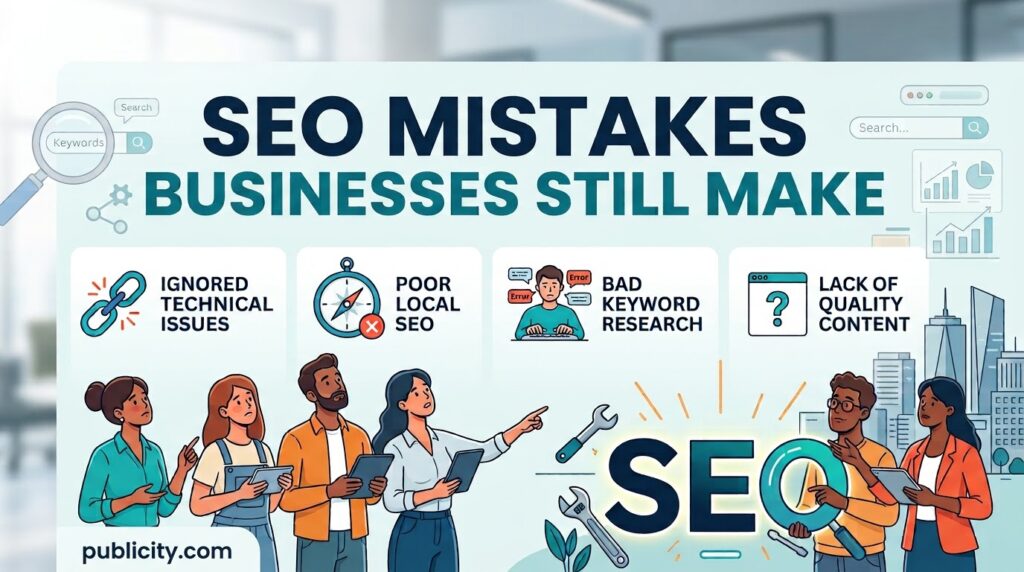
Search engine optimization can be one of the most valuable marketing strategies available to a small business.
A business that appears when potential customers are searching for its products or services can generate traffic, inquiries, bookings, and sales without paying for every individual click.
But SEO is also one of the areas where small businesses can waste significant amounts of time.
Some businesses spend months adding keywords to their websites without seeing meaningful results. Others publish dozens of articles that nobody reads. Some focus almost entirely on rankings while ignoring whether their website actually converts visitors into customers.
The problem is often not that the business is doing too little SEO.
It is that the business is focusing on the wrong things.
Search has also changed considerably. Search engines have become better at understanding topics, context, intent, and the quality of information. Customers increasingly use social platforms and AI-powered tools to discover information as well.
That means small businesses need a more complete approach to search visibility.
Here are some of the most common SEO mistakes small businesses still make and what they can do instead.
1. Treating SEO as Simply Adding Keywords
One of the oldest SEO mistakes is assuming that ranking is primarily about putting the right keyword on a page as many times as possible.
A business might create a page targeting:
“best accountant in Leeds”
and repeat that phrase throughout the article.
The keyword might appear in the title, introduction, headings, paragraphs, image descriptions, and conclusion.
But excessive repetition does not automatically make a page useful.
Search engines have become much better at understanding language and the overall subject of a page.
More importantly, customers do not want to read content that sounds like it was written for a search engine.
A better approach is to understand what the person searching actually wants.
Someone searching for an accountant may want to know:
- What services the accountant provides
- How much accounting services cost
- Whether the accountant works with small businesses
- Whether they handle personal taxes
- What qualifications they have
- Where they are located
- How to contact them
- What makes them different from other accountants
The goal should be to answer those questions naturally.
Use relevant terminology, but write primarily for people.
2. Creating Pages for Every Slight Keyword Variation
Another common mistake is creating separate pages for every variation of essentially the same search.
For example, a business might create individual pages for:
- Accountant in Leeds
- Accountants Leeds
- Leeds accountant
- Accountant near Leeds
- Best accountant Leeds
- Accounting services Leeds
There may be legitimate reasons for having multiple pages in some circumstances, but creating large numbers of nearly identical pages can produce a confusing website.
A better strategy is often to create one strong page that thoroughly addresses the topic and naturally covers related questions and terminology.
The page should have a clear purpose.
Ask:
What does this page provide that another page on the website does not?
If the answer is nothing, creating another page may not improve the site’s SEO.
3. Publishing Content Just to Increase the Number of Articles
More content is not automatically better.
This is particularly important now that AI tools make it extremely easy to produce articles at scale.
A business can generate 50 blog posts in a short period of time.
But if those articles are generic, repetitive, inaccurate, or provide little original value, the business has not necessarily created a valuable SEO asset.
It has simply created more pages.
A better approach is to publish fewer but more useful articles.
For example, a local roofing company might benefit more from ten genuinely useful guides such as:
- How Much Does a New Roof Cost?
- How to Tell If Your Roof Needs Repair
- Roof Repair vs Roof Replacement
- How Long Does a Roof Typically Last?
- What to Do After Storm Damage
- How to Choose a Roofing Contractor
These topics directly address customer problems.
They can also naturally support the company’s commercial service pages.
4. Ignoring Search Intent
Search intent is one of the most important concepts in SEO.
It refers to what someone actually wants when they perform a search.
Consider the search:
“best accounting software for small businesses.”
Someone searching this may want comparisons and recommendations.
They probably do not want a page that simply advertises an accounting firm’s services.
Now consider:
“accountant near me.”
That search has a much stronger local and commercial intent.
The person may be looking for an actual provider.
The content should therefore match the purpose of the search.
Before creating a page, ask:
What does the person probably want to accomplish?
Then create the page accordingly.
5. Ignoring Local SEO
For businesses that serve specific locations, local SEO can be extremely important.
A plumber in Birmingham does not necessarily need to compete for searches from people across the entire country.
They need to be visible to people who need plumbing services in the areas they actually serve.
Small businesses should make sure their location and service areas are clearly communicated.
That can include:
- A complete business profile on relevant platforms
- Accurate business name, address, and contact information
- Service-area information
- Location-specific website content where appropriate
- Customer reviews
- Local business information
- Useful location pages when there is a legitimate reason for them
But businesses should avoid creating dozens of thin location pages simply by changing the city name.
A page about “Plumber in City A” and another about “Plumber in City B” should provide genuinely useful information about those locations if both pages are going to exist.
6. Forgetting About the Google Business Profile
A website is not the only place customers can discover a local business.
For many local companies, the business profile that appears in search and maps can be extremely important.
Businesses sometimes spend thousands on a website while neglecting their basic business information.
Make sure the profile is accurate.
Check:
- Business name
- Address
- Phone number
- Website
- Opening hours
- Services
- Business category
- Photos
- Customer reviews
Customers often make decisions based on this information before they ever visit the company’s website.
7. Building a Slow Website
SEO is not only about words.
The experience visitors have after clicking a search result matters too.
A website that takes a long time to load can frustrate visitors, particularly on mobile devices.
Small businesses should regularly test their websites on both desktop and mobile devices.
Look for:
- Slow-loading pages
- Huge image files
- Unnecessary scripts
- Poor mobile layouts
- Broken links
- Difficult navigation
- Intrusive pop-ups
- Pages that are difficult to read
A technically perfect website is not required to succeed in search.
But a website that consistently provides a poor experience can make it harder to turn search visitors into customers.
8. Using Poor-Quality Images
Images are often treated as an afterthought.
A business might upload a blurry logo, an enormous stock image, or an unrelated photograph simply because a page needs an image.
Images should support the content.
A restaurant should ideally show its food, location, atmosphere, or actual customer experience.
A real estate company can use property photography.
A contractor can show completed work.
A consultant might use professional photographs, diagrams, or relevant visual content.
Images should also be appropriately sized so they do not unnecessarily slow the website down.
9. Ignoring Internal Links
Internal links are links from one page on a website to another page on the same website.
They are often overlooked because businesses tend to focus on getting external backlinks.
But internal linking can help visitors discover more relevant information and can help search engines understand how pages on a website relate to each other.
Imagine a marketing agency publishes an article called:
How to Create a Social Media Strategy
That article could naturally link to related resources about:
- Social media advertising
- Content marketing
- SEO
- Email marketing
- Digital marketing services
The links should make sense to the reader.
Do not add internal links simply to increase the number of links on a page.
10. Obsessing Over Backlinks
Backlinks can be valuable.
But some businesses have become so focused on acquiring backlinks that they forget why people visit websites in the first place.
A backlink from a relevant, reputable website can help establish visibility and authority.
But collecting hundreds of low-quality links from unrelated websites is not necessarily a good SEO strategy.
Small businesses should focus on earning relevant mentions through things such as:
- Useful content
- Industry relationships
- Local organizations
- Professional associations
- Public relations
- Genuine partnerships
- Original research
- Expert contributions
- Community involvement
The objective should be to build a credible online presence rather than simply accumulate links.
11. Using Exact-Match Anchor Text Everywhere
Anchor text is the clickable text used in a link.
A business trying to rank for “digital marketing agency Miami” might be tempted to use that exact phrase every time another website links to it.
That can look unnatural.
Real websites use many different types of language when linking.
A business might naturally be mentioned as:
- ABC Marketing
- Learn more about the company
- Visit their website
- This Miami marketing agency
- ABC Marketing’s services
SEO should reflect how people naturally communicate.
The goal should not be to manipulate every link into containing a particular keyword.
12. Buying Cheap SEO Packages
Small businesses are often approached with inexpensive SEO offers promising hundreds of backlinks, guaranteed rankings, or rapid results.
These offers can be tempting.
But SEO is rarely as simple as purchasing a fixed number of links.
A company should understand what an SEO provider is actually doing.
Ask questions such as:
- What exactly will you change?
- How will you measure progress?
- What type of links are you building?
- How will you choose target keywords?
- What technical problems have you identified?
- How will you report results?
- What happens if the strategy does not work?
Be especially cautious about guarantees involving specific Google rankings.
Search results are influenced by many factors, and nobody outside the search engine controls exactly where a website will rank.
13. Ignoring Existing Content
Some businesses constantly create new articles while leaving old content untouched.
That can be inefficient.
Older pages may already have backlinks, impressions, rankings, or historical traffic.
Instead of immediately creating another article, look at what already exists.
An older article might benefit from:
- Updated statistics
- Better examples
- Additional sections
- Improved formatting
- New internal links
- Better images
- Updated business information
- A clearer title
- A stronger introduction
Sometimes improving an existing page can be more valuable than creating another page targeting the same subject.
14. Forgetting to Connect Informational Content to the Business
A business might publish an excellent article that receives search traffic but produces no customers.
Why?
Because the article never explains what the company actually does.
Informational content should still have a logical connection to the business.
For example, a landscaping company could publish:
How Often Should You Water a New Lawn?
At the end of the article, it could naturally explain that customers who need professional lawn installation or maintenance can contact the company.
That is much better than turning the entire article into a sales pitch.
The content should help first and sell second.
15. Writing Only About the Business
Another mistake is making every article an advertisement.
Potential customers generally do not search for:
“Why is Company X the best company?”
They search for problems they need to solve.
Instead of writing dozens of articles about the company’s achievements, think about the customer’s questions.
A home renovation company could write about:
- How much does a bathroom renovation cost?
- What should you ask a contractor?
- How long does a kitchen renovation take?
- Which materials are easiest to maintain?
- What mistakes should homeowners avoid?
This creates content around customer needs.
16. Ignoring Brand Reputation
SEO is not completely separate from branding.
A business that appears prominently online but has poor reviews, confusing information, outdated social profiles, or inconsistent branding may still struggle to convert visitors.
Customers want to know:
Can I trust this company?
A strong online presence should therefore communicate credibility.
That means keeping information accurate, responding professionally to customers, publishing useful information, and maintaining a consistent brand identity.
Search visibility gets people to the door.
Trust helps get them through it.
17. Expecting SEO Results Immediately
SEO usually takes patience.
A new website may need time to build visibility.
A competitive keyword may take significant effort to rank for.
An article may perform poorly at first and gain traffic later.
That makes measurement important.
Instead of checking rankings every day, businesses should look at broader trends.
Useful measurements can include:
- Organic traffic
- Search impressions
- Search clicks
- Relevant keyword visibility
- Leads
- Phone calls
- Form submissions
- Sales
- Engagement
- Pages that attract visitors
The ultimate goal is not simply ranking number one.
The goal is attracting the right people and turning some of those visitors into customers.
18. Ignoring Mobile Users
A significant portion of internet activity takes place on smartphones.
Yet some small business websites are still designed primarily around desktop computers.
A business should regularly visit its own website from a phone.
Can you read the text easily?
Can you navigate the menu?
Can you find the phone number?
Can you complete the contact form?
Do images fit properly?
Does anything overlap?
A website can technically be mobile-compatible while still providing a frustrating experience.
Always test the site as a customer would.
19. Treating AI-Generated Content as an SEO Shortcut
AI has changed content production dramatically.
Businesses can now generate articles, product descriptions, social posts, FAQs, and other material very quickly.
But generating content is not the same as creating valuable content.
Publishing large quantities of generic AI-written material without fact-checking, editing, expertise, or originality can result in a website filled with pages that provide little value.
AI can be useful for:
- Brainstorming
- Research assistance
- Outlining
- Editing
- Repurposing
- Summarizing
- Organizing information
But businesses should add their own expertise and verify important claims.
The best use of AI is often to make good content easier to produce rather than to make low-quality content faster.
20. Focusing on Search Engines Instead of Customers
Perhaps the biggest SEO mistake is forgetting who the content is actually for.
Businesses can become obsessed with algorithms, keywords, rankings, backlinks, technical scores, and traffic numbers.
All of those things have their place.
But the customer is still the reason the website exists.
If someone lands on a page, can they understand the answer?
Can they find what they need?
Do they trust the business?
Can they easily take the next step?
If the answer to those questions is no, a number-one ranking may not produce much value.
SEO Is Becoming More About Being Useful
The future of SEO is not necessarily about abandoning keywords, links, technical optimization, or search rankings.
Those fundamentals still matter.
But small businesses should think about SEO as part of a larger visibility strategy.
Customers can discover businesses through traditional search engines, maps, social platforms, online publications, reviews, communities, referrals, and increasingly AI-powered tools.
That means businesses need to build a presence that is useful across multiple discovery channels.
The strongest strategy is not simply:
“How can I get Google to rank this page?”
It is:
“How can I become a useful and trustworthy source of information for the people I want to serve?”
That shift can change the way a small business approaches its entire online presence.
Instead of creating content simply because someone says they need more blog posts, businesses can create resources that answer real questions.
Instead of buying hundreds of questionable backlinks, they can build relationships and earn legitimate mentions.
Instead of stuffing keywords into every paragraph, they can create clear and comprehensive pages.
Instead of publishing dozens of generic AI-generated articles, they can use AI to help turn real expertise into better content.
And instead of measuring SEO success only through rankings, they can measure whether search visibility is actually producing qualified customers.
SEO Is still Alive
Small business SEO does not need to be complicated.
The fundamentals are often surprisingly simple.
Understand what customers are searching for.
Create useful information.
Make your website easy to use.
Keep business information accurate.
Build a credible reputation.
Connect related content.
Earn relevant mentions.
Use technology intelligently.
And most importantly, remember that search engines are not the customer.
People are.
As search continues to evolve and AI becomes a larger part of how people discover information, businesses that focus on usefulness, expertise, accuracy, and trust will have a stronger foundation than businesses that rely on shortcuts.
SEO is not about publishing the most content or using the most keywords.
It is about making it easier for the right people to discover the right business at the right time.
Lets highlight your brand?
Promote your article on Publcity to showcase your business, expertise, services or ideas.
Explore Sponsored Publishing Options → Promote your existing article choose our Write-for-you option.Submit Free Guest Posts
Have an original story, useful insight or professional perspective to share? Publcity welcomes contributions across Business, Marketing, Technology, Travel and Culture.
Review the submission guidelines before sending your article.